Equipment used for low resolution stellar spectroscopy
Equipment comprises:-
Sigma camera lens
(150-500 mm zoom for Canon EOS),
TS
(Teleskop-express.de) slim Canon EOS lens to T2 adapter (length 10 mm),
TS Optics Quick
Change Filter Drawer system with drawer for 1.25" filter,
Star Analyser 200
(200 l/mm blazed grating, comes mounted in a 1.25" filter ring),
QHY9 mono CCD
camera.
+ motorised
equatorial mount (Sirus EQ-G).
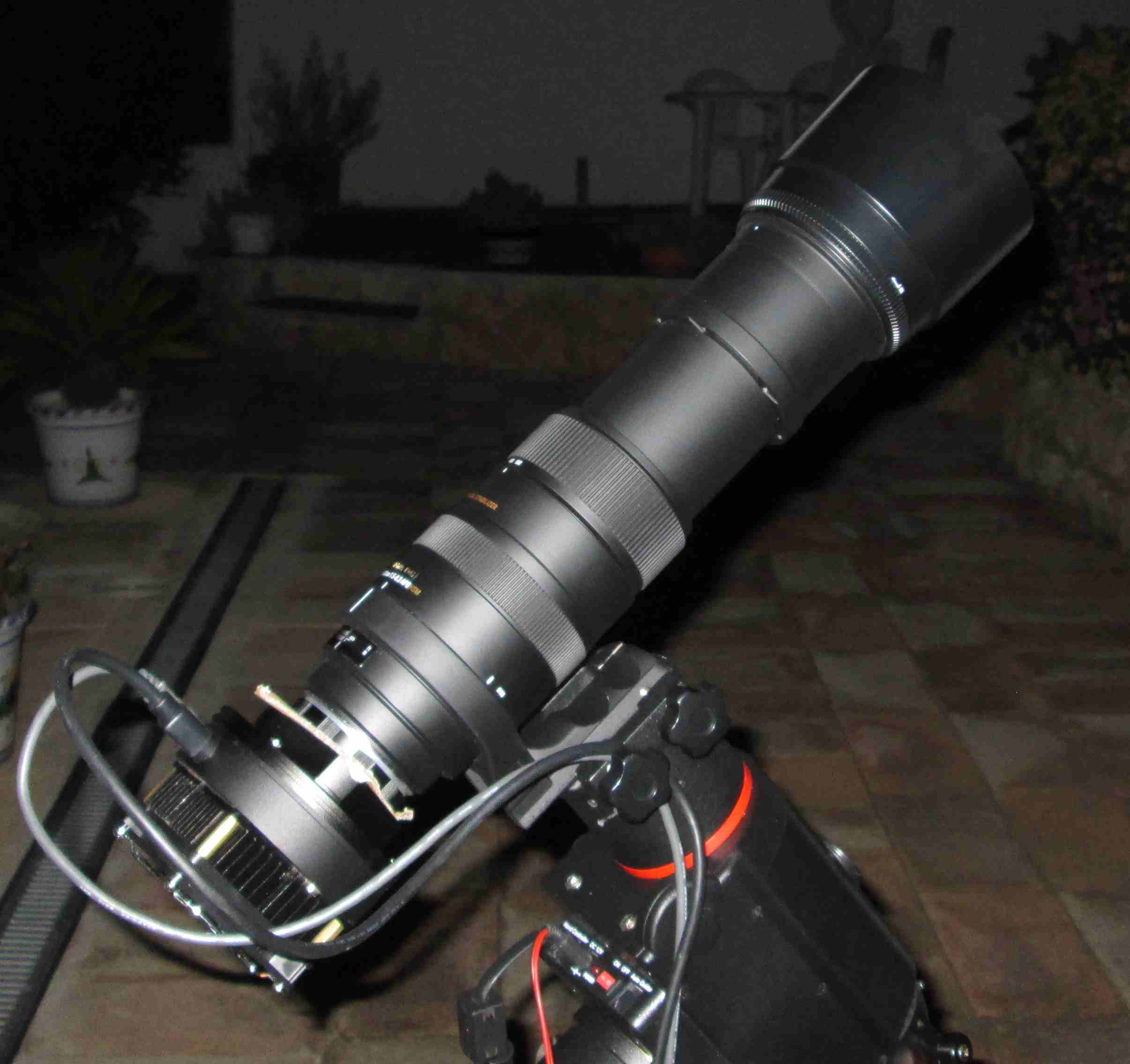

This arrangement was originally set up for taking wide-angle narrow
band photos of large nebula, but is ideal for low resolution
stellar-spectroscopy.
Using the grating in the converging beam, this slit-less configuration
relies on the star image being as small and stable as possible (ideally
a stationary point source). Higher magnification (with a telescope)
amplifies any movement of the star due to the atmosphere, which
greatly reduces the resolution of the end result.
A home-made cardboard washer (2nd photo) between the adapter
and filter drawer helps to prevent the T2 thread of the adapter going too
deep into the filter box, fouling easy removal of the filter drawer,
and also allows adjustment of the camera to align the sensor's
horizontal/vertical axes with the RA/Dec.
Although a zoom lens might be frowned upon by most astronomers, on a
mount that has to be erected/dismantled every night it provides a very
neat, portable solution, and makes initial alignment of the mount very
easy before zooming in to use the full diameter of the objective. The
relative low magnification means the motorised drive easily allows
exposures of 30 seconds without the need to set up an auto-guide scope,
with inital tests indicating exposures of 1 second for Vega, and 15 to
30 seconds for stars from mag 7 to 10.
The above gives a plate-scale of 11-12 Angstroms/pixel.
The resolution (yet to be measured) is probably most dependant upon the atmospheric conditions on the night.
Return to Menu